Trying a New Approach to Collaboration, Large and Small

When I think of horrific meeting experiences, my mind rewinds to a hands-on seminar I led years ago for Apple. The objective was to introduce teachers to Apple’s desktop. It was a group presentation with auditorium-style seating and keyboards for participants to use in conjunction with the talk. About 10 minutes into my sch-peel, a tiny grandmotherly-looking woman stood up and said to the group: “We’re not idiots. Why do we have to listen to this person, let’s just do this!”  And away they went, clicking happily along in utter chaos. That was point my boss walked in. Needless to say it was an interesting debrief.

meeting
The 20th century approach to informing, educating and convincing a group of people. 

I thought about that woman this week during a Liberating Structures workshop led by Keith McCandless (who wrote the book) and Anna Jackson who spearheads an LS meetup group here in Austin. Is there a better way to inform, collaborate, teach and motivate a group of people?  I’m a newbie but I’d say the tools they introduced me to are the best I’ve seen so far. I can see how they could work in all kinds of organizations. The idea is to tweak the feng shui of group interactions – topic, space, pacing, participation – and deploy a set of tools that better focus and distribute the conversation among the people who matter.

liberated meeting
Are there more possibilities here? Bigger group, more leaders. See the 1-2-4-All tool.  

You can read more on the Liberating Structures website. It lists all the tools and gives you a menu of when/how to apply them.

Since I haven’t applied it yet, the results are theoretical. But hey, if it works for The World Bank and The Gates Foundation, I’m all in. I’m intrigued about seeing how the tools would work cross-culturally, in situations where some of the participants are remote (there’s a technology conversation) and when selling one’s ideas to executives.

More to come.  I only wish I, like Merlin, could live backwards: Just think how I could have helped and gained from that woman who was so frustrated and anxious to learn so long ago.  I hope she’s running a company somewhere.


Stuck in a Habit: Is Predictive Adaptation Possible?

Editor’s Note:  I was thinking about this post in terms of a session on Predictive Adaptation I sat in on last month. Dr. Liz Alexander moderated. She is considering a book on the subject which boils down to:

Can we stay tuned in enough to adapt prior to a change in our marketplace?

As the shelf life of companies grows shorter and shorter, the ability to adapt is on the short list of survival strategies. How do we cultivate it? One way is to not be stuck in our habits.

I’m a tea drinker, I have a teapot with an infuser, numerous immersion devices and a cabinet stuffed full of teas – black, herbal, medicinal, green. When I drank coffee, it was the same scenario, with different props. My freezer was full of Peets’ (now, alas, part of Starbucks) Major Dickinson blend and my cabinet, coffee brewers — drip, stovetop, percolator, French and Italian press – you get the drift.

Habits can lock us into rigid ways of thinking and doing.
Habits can lock us into rigid ways of thinking and doing. The solution?  Try something new.

Two weeks ago I ran out of tea. I reordered in a such a panic that I used an old address.  My tea — a special blend I’d grown to depend on to get me out of the door in the morning — never arrived. The tea blender refused to fix the delivery snafu.  So I didn’t reorder.

That’s how one habit (getting in a snit when things didn’t go my way) forced me to re-evaluate another (my tea drinking compulsions).  I was forced to rethink that morning ritual. Now I’m brewing tea bags (Choice) I buy at the grocery store.  I don’t enjoy my tea nearly as much, but it’s saving me time. Unintended consequence:  I’m actually getting to work on time.

Habits can be helpful, but they can also lock us into position. I’ve noticed that whatever it is hoard is a habit – wine, ice cream, tea, coffee, graham crackers. In the same way, my response to the tea blender was a habit — he chided me about my carelessness, I felt like a bad child, and I didn’t want anything more to do with him.  Other habits I’ve flagged since my tea disruption:

  • Who I greet in the morning
  • Where I walk the dog
  • What I do with my spare time
  • Who I telephone to spend time with
  • How I think about my abilities (and shortcomings)
  • The books I read
  • How I view people with ideas that are different from mine

A search on “habits” took my to former Googler Matt Cutts’ Ted Talk, “Try Something New for 30 Days.” (Editorial note:  Why is the guys can look like slobs and the women have to look like they’re ready for the Academy Awards?)  Regardless, I’ve resolved, for at least 30 days (when Choice tea bags will probably already be my new habit), not to reorder tea.  We’ll see what happens.

Who knows what I’ll discover.


Can We Adapt Before Change Happens?

If a lifelong attraction to fortune tellers has taught me anything, it’s that the future never turns out according to plan. And a planner I’ve always been.

So I was fascinated when Dr. Liz Alexander posed the question:  Can we adapt predictively?  That is, can we read trends wisely enough to see what will be required for a future that’s still around the corner?

Liz, who among other things, guides thought leaders through the process of articulating and packaging their theories, pointed out that if:

  • The past is a predictor of the future
  • Corporate shelf life continues to drop (it’s now in the low double digits)
  • We remain flexible professionally, accepting that each of us will have multiple professions during our working life
  • Then, if we pay attention to mega trends, we can determine where our professional strengths can best be applied

So much depends on seeing opportunity when it presents itself.  I pulled myself away from watching the Democratic National Convention to write this. Al Franken, former comedian, current U.S. senator spoke, and I was struck by Gail Collins’ oped piece pointing out that Hillary Clinton is running for president at a time when most women are thinking about gardening, grandchildren and the occasional cruise.

These are remarkable people, obviously, but they are also tips of an iceberg of change, reminding us to stay flexible, pay attention and don’t be afraid of opportunity.  Maybe that in itself is predictive adaptation.


Leadership During a Crisis: Dallas Co. Sheriff Lupe Valdez on Police Shootings

A very, very sad week for our country: four shootings in cities across the country, with five police officers shot in Dallas during a peaceful “Black Lives Matter” protest. Sitting here in the middle of Texas, I am heartsick for my state and for Dallas, which for some reason has been a magnet for tragedy. Despite a vacuum (at best) of leadership among our state’s elected officials, I take my hat off to Lupe Valdez, sheriff of Dallas County.

Dallas Co. Sheriff Lupe Valdez, "I know at some point I'll cry," Courtesy of the Dallas Morning News
Sheriff Lupe Valdez, “At some point I’m going to cry. But right now I’m too busy.” Photo courtesy of the Dallas Morning News

Valdez, who is in her third term at the helm of a racially diverse county and the state’s second-largest city, spoke to NPR yesterday, responding openly and honestly to questions that would have made many others defensive (take note, Mrs. Clinton). She explaining why she was “not comfortable” with law enforcement officers’ wearing riot gear during citizen protests: “You put people in riot gear, you’re saying we’re expecting you to misbehave, so we’re ready for you….”

She closed with one of the most human “official” statements I’ve heard:

“I think – what I hear a lot and what I feel is – or what I’ve said a lot today – at some point, I’m going to cry. But right now I’m too busy. Right now we need to take care of things. But I think that’s important for all of us. At some point, it’s going to hit us. But right now we’re just, as I said, we’re good at crisis. We react. We do what needs to be done.”

Thank you, Sheriff Valdez.

What Does An American Look Like?

My friend Prithvi was sworn in this week as a U.S. citizen. Here’s an excerpt from our conversation about the experience:     Swearing in

The ceremony was beautiful.One thousand one hundred sixty-six (1,166!) people from 97 countries participated. After waiting outside for about 30 minutes, we took the oath and a lovely band played the “Star-Spangled Banner.”  It was an emotional moment.

Several judges spoke about the United States being a nation of immigrants and as new citizens, our enriching that heritage. They encouraged us to tell our stories and enrich America with our culture.

A woman judge told a story about a Bangladeshi immigrant who became a citizen.  When he was shot after 9-11, he sued to stop his assailant’s execution. We were strongly encouraged to vote:  There were voter registration desks in every corner of the building.

The head of the immigration service there, whose grandfather was from Mexico, asked us what an American looks like.  Then he said, “This!” and gestured at us.  Each country was called out, and the people of that country were asked to stand. Then he said, “Mexico,” and everyone remaining stood up.  There was roar from the stadium.

Prithvi is from Mangalore, India. She is brilliant and well-rounded: a technical manager at Apple, the mother of a three year old, the wife of an equally brilliant engineer.  She also runs a non profit for Indian children. I can’t imagine anyone’s taking issue with her becoming a citizen.

I asked her how it felt to be an American.

I don’t known what that means. I have felt American for a while.  And Indian.  That will not go away.

Prithvi’s experience was a reminder of what we’re about — and it’s not those plastic American flags realtors insist on sticking in everyone’s yard, nor the mattress sales, nor the grocery store aisles clogged with overflowing baskets.

At a time when our world’s politics are compared with — heaven forbid –“Game of Thrones,”  let’s try our best to rise to the occasion, to return some of what we’ve been given — to read, listen critically, write our elected officials and vote. Let’s try our best to make things better.


SXSW Interactive: Can design change the way we think about healthcare delivery?

Can we use the creativity and rigors of the design process to change how we deliver health care?  After a week of SXSW Interactive, I’d say yes, it makes sense and certainly couldn’t hurt. After over a decade seeing two parents through the Kafka-esque twists and turns of the health care system, I consider the American approach to delivering medical (and elder-) care on par with Chinese water torture, only more expensive.

Pauline van Dongen's solar-paneled dress prompts us to re-examine why we wear clothing. Why not apply that same thinking to health care?
Pauline van Dongen’s solar-paneled dress prompts us to re-examine why we wear clothing. Why not apply that same thinking to health care?

Here in Austin, The University of Texas announced a radical-sounding partnership between the Dell Medical School and The University of Texas Dept. of Art called The Design Institute for Health. The newly-formed group, led by two veterans from IDEO, the design firm famous for its longstanding relationship with Apple, are part of a push to figure out how to deliver community-based health care funded based on the “value it creates.”  The medical school’s charismatic dean, Dr. Clay Johnston, is inviting hospitals, doctors, nonprofits and the community as a whole to help re-think what the farm animals in the movie “Babe called “the way things are.”  I can’t imagine many things more challenging, or exciting.

If you have any doubts about the mind-unleashing power of design, I refer you to Paola Antonelli’s SXSW keynote, “Curious Bridges: How Designers Grow the Future.”  Antonelli, the curator of architecture for the Museum of Modern Art, guides us through a series of examples of design that provokes us to re-think the “way things are.”  Examples include a belt that simulates menstruation (to, one presumes, produce empathy in the opposite sex) and wearable clothing made with 3D printers that simulates the body’s movement created by Pauline van Dongen, who wore a sweater made of flattened solar cells during her session later that day. Think about it, technology-based clothing that’s comfortable, practical and adaptable.

Design was the subtext of a fascinating but sparsely-attended talk by Eric Topol’s called “Democratizing Health Care.” Here is a doctor, researcher and (I have to assume) AMA member, who understands that people want healthcare to be simple, affordable and effective. After opening his talk by citing medication errors as the fourth cause of death in the United States, Topol showed a portfolio of on-demand tools — a wrist band to detect seizures, an app to measure arrhythmia, or using a smartphone to digitize the heart — technology moving at the pace of Moore’s Law to troubleshoot, coordinate and identify illness — without causing the patient to go broke or die.  I don’t think any of the devices Dr. Topol showed were ready for prime time, but they they — or improved versions — will be, and they will advance the revolution.

Why not?  If we can cast off stilettos and create sympathy for PMS, why not re-think health care as a human service for real people?

Appreciate the process

I am firmly convinced there are no straight lines. The goal may be clear – a speech, successful meeting, signed contract — but the path rarely maps with the project plan. A colleague once told me she kept on course by reminding herself to enjoy the process.  These days, I try hard to apply that formula to both my work and my life.

There are no straight lines in life or in work. (Photo courtesy of pimpmycom.com)

A friend whose long career includes a Fulbright at age 67, assignments on four continents, a tenured professorship and a close network of fascinating friends told me recently that he realizes now that he was just “stumbling along,” working hard, yes, but seizing opportunities and accepting setbacks as they appeared.

Another term for “stumbling along” might be innovation. A client of mine sells small-batch Irish whiskey, and as I listened to one of his distillers talk about merging technology (containers, process) with the centuries-old tradition of whiskey making, I thought, “no straight lines, ” rather a series of trials with error and the occasional stellar success. How many times have we heard the homily: many of life’s failures are people who did not realize how close they were to success when they gave up.

As much as I think I would like a “happily ever after” plot line, admittedly, it’s been the bumps in the road that have taught me the most and made the trip interesting.  I certainly didn’t plan to take a career hiatus in my 50’s to care for my parents, but I did, dialing back my professional activities and focusing on managing their finances, medical care and stops at more “care continuums” than I care to count.  It didn’t make me rich, but it gave me a sense of compassion that I never would have gained in the corporate world.

Remembering this, I remind myself not to panic if the plane is cancelled or a stray dog appears on the doorstep just as the project is due. It’ll be okay; there are no straight lines.

Small Successes

I’ve been thinking a lot about small successes.  The ones that encourage us to take the next step. It all started when a group of friends and I took in a dog whose owner, also a friend, died. A trainer recommended rotating the dog, Indie, through four foster homes over a month’s time. The goal was to make her more confident.  I’m not sure if she went into shock or truly became more adaptable, but by the end of the month, she seemed ready for anything.

Or maybe she just figured out that whatever it was she feared losing wasn’t worth it.

It’s become very popular to tout innovation and risk taking, but Indie’s experience seems to be the case more frequently than not. We take one step, a project, a cold call, a blog post. It doesn’t kill us, so we try another.  As time passes, we get bigger, hopefully in our hearts as well as our ambitions. Somehow it all works out, though maybe not as we planned. But hey, that can be good. Remember the Post It?

Orphan cattle dog Indie's experience showed me that small successes change us for the better.
Orphan cattle dog Indie’s experience showed me that small successes change us for the better.

Most useful was the push back I received from people who thought we were doing the wrong thing.  After all, it’s very possible she would have arrived at the same point had she been in one, much less confusing, spot.

But the passionate people brought to their protest drove me nuts. I had to go back to Eisenhower’s famous back-up note he crafted as a statement should the D-Day landing have failed (yes, a bit dramatic but whenever you can call on greatness, do it!)

“Our landings in the Cherbourg-Havre area have failed to gain a satisfactory foothold and I have withdrawn the troops. My decision to attack at this time and place was based upon the best information available. The troops, the air and the Navy did all that Bravery and devotion to duty could do. If any blame or fault attaches to the attempt it is mine alone.”

Back to Indie. She’s still an orphan. Cattle dogs aren’t trendy these days.  Loyal, attentive, protective, they have their faults. But also their strengths: absolute devotion to their owners, the ability to break away from a momentum (eating, growling at another dog) to attend to their person. In other words, they’re imperfect, just like us.  So I know she’ll keep trying.

Beyond likeability: Women leaders on issues that matter

Perhaps we’re getting over the likeability debate. This week, two women at the top of their games cut to the chase and point out a few elephants in the room.

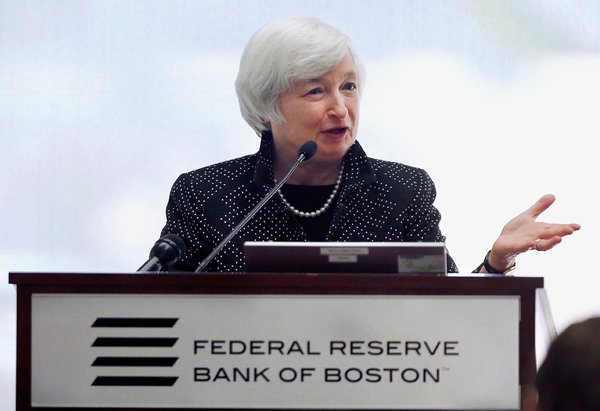
Janet Yellen used her role as Fed chairman to start a conversation on economic opportunity. Why are more Americans locked into a vicious cycle of poverty? “I cannot offer any conclusions. (But) I do believe that these are important questions.”

You bet they are. And thank you, for having the guts to say so.

Janet Yellen inviting a discussion on the growing gap between rich and poor
Fed Chairman Janet Yellen stepping out of her role to invite a discussion on the gap between rich and poor

Then, last evening I watched Pulitzer Prize-winning author Marilynne Robinson talk about, among other things, why we don’t seem to be able to have a civil conversation about anything that matters. I wish I had a transcript, so I’m paraphrasing, but in essence she marveled about our penchant for turning complex issues into a SNL skit. As above, so below: entertainment trumps facts and respectful debate.

Pulitzer Prize winning Marilynne Robinson on the dumbing down of our public conversations

Both Yellen and Robinson have white hair. If ever we wanted role models, here they are, juggling, multitasking their way through successful lives, showing the rest of us how it’s done. Both went to public schools; Robinson was a single mother. It’s interesting Yellen waited until she had the top job before speaking publicly about a topic outside of her mandate. She was a loyal vice chair. Unlike some of her colleagues, she supported her team.

My takeaway was this: “Don’t waste my time. Let’s get together to work on things that matter.”

Take a Moment to Be Quiet

It’s Sept. 11, which is now far enough in the past that many people don’t remember the horror of the day.

But there’s much to be said for pausing to remember that anything can happen at any moment.

Carve out a quiet moment.   (Courtesy of apps.carlton.edu)
Carve out a quiet moment.                                                                                                                                               (Photo courtesy of apps.carlton.edu)